
Grace or Mercy

Who’s up for a story? I thought I’d share this one with you. I told it to my son, and he seemed to enjoy it, so if you don’t, blame him.
John Newton was, by all accounts, not a good man. John was born in London in 1725. His father was a shipmaster serving in the Mediterranean, so John basically grew up without him being a part of his life. He had a wonderful mother, Elizabeth, a sickly, frail woman who doted on John, reading to him, attempting to ready him for the world by giving him as much preparation as she could.
The second major event that shaped John (his father being absent was the first) was the death of his mother just two weeks before his 7th birthday. She died of consumption. We use a different word for that disease today: tuberculosis.
Enter event number 3: after the death of his mother, his father did not come home to raise him; instead, he was sent to a boarding school for two years. We are starting to see the planks of his life building his personality. After two years, his father did send for him, introducing him to his step-mother, who was now in charge of his development. At the age of 11, his parents agreed that it would be a good idea for him to go serve on a ship with his father. Most kids today would be in the 5th grade at school, but John was risking life and limb on the open sea. The hardening of his heart continued.
John completed six voyages with his dad before the elder decided to retire. He wanted John to run a sugarcane plantation in Jamaica, but John decided that he liked sailing and signed on with a merchant ship.
At the age of 18, John decided to visit friends. In a not uncommon act, he was taken into custody, for no reason, and pressed into service by the Royal Navy. He was assigned to the HMS Harwich, and at one point, tried to desert. He failed. His punishment was to be stripped to the waist and flogged in front of the crew. Another couple of events that led John to become the man he did. He considered killing the captain or himself. In the end, he did neither, but he did make it a priority to get off that ship.
While in port in the West Indies, he decided to leave the Harwich to sign on with the Pegasus. The Pegasus was a slave trading ship. The angry young man made many enemies on that ship, so much so that the captain threw him off the ship and left him with a slave trader in Africa. That man gave him as a gift to his wife, who treated him like a slave. He recounted later that her cruelty knew no bounds. One more reminder of how life shaped John Newton.
This lasted for two years before the captain of the Greyhound found him. Yes, found him because John’s father feared for his safety and asked the captain to look for him. The ship set sail for England. The Greyhound was a ship that was meant to sail near coasts in warm waters, but a brewing storm pushed it out farther into the sea than it was built for. John went to his cabin to try to sleep while the ship was tossed. John was startled awake when he heard the horrible sound of ocean water invading the hull of the ship. He heard men yelling, including one man who told him to get to the deck before it sank. You can imagine how fast John started moving, following the fellow to the top. Right before he got there, he heard the captain yell his name: “Mr. Newton, don’t go on deck, come here, we need you!”. Being a sailor, John followed orders and headed down. The man who made it to the deck was swept overboard by a wave and never seen again.
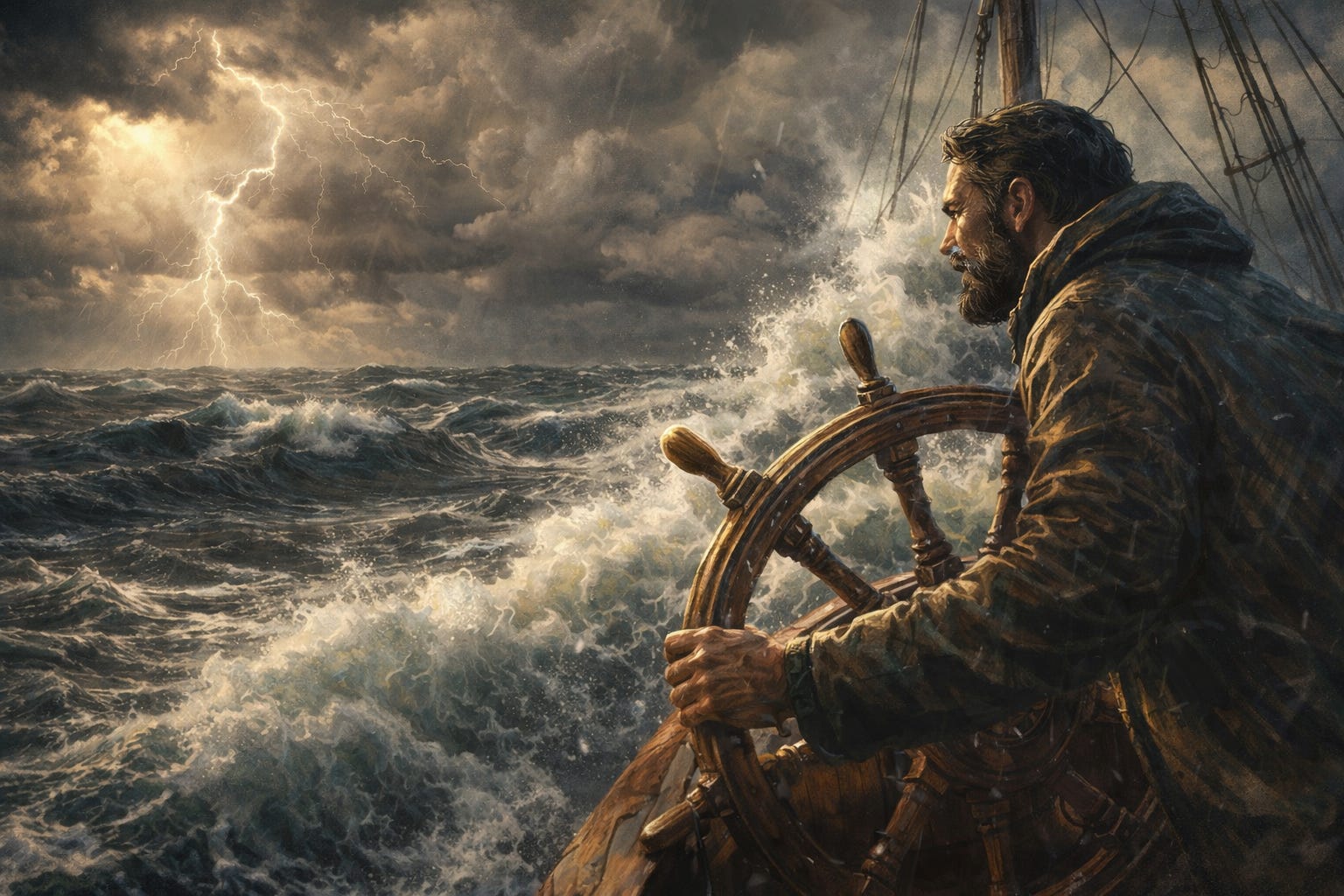
John joined the captain and the rest of the crew, bailing water out. John found the ship’s pump and started manually pumping the water. He did this non-stop from 3 a.m. until roughly noon the next day. When he could stop, he lay down, trying to rest. But there was no time. The captain took John to the wheel and strapped him to it, giving him the command to steer the ship while the rest either bailed water or tried to rig the sails.
The storm raged on. It is this point of the story to tell you about John’s beliefs. The truth is, he didn’t have any. His mother read the Bible to him every day and tried to prepare him for life by teaching him lessons from scripture. But when she died, he had no use for religion. In fact, he became an ardent evangelical atheist by his account. He would actively seek out Christians to try to destroy their faith. So as he stood strapped to the wheel of the vessel, with the storm raging around him and the waves literally crashing over his head, he considered praying. He resisted it, not wanting to give in to what he thought was a weakness. However, he knew death was a very real possibility, so he did pray. He prayed for mercy; he didn’t think he could ask for anything more. Grace is getting what you don’t deserve; mercy is not getting what you do deserve.
The winds started to die down. The waves calmed. The ship held together. This began John’s transformation. He prayed every day, and when they finally made port in Ireland after four weeks, one of the first things he did was to go and purchase a Bible. It wasn’t magical. It wasn’t instant. John continued to work in the slave trade, captaining three slave ships. He married his childhood sweetheart. He adopted his wife’s two nieces, who had been orphaned when their parents died. He battled health issues. He finally could no longer rationalize being a part of slavery and joined organizations with the goal of abolishing the institution, referring to it as a great stain on our nation and mankind.
In 1767, John served as a minister of a church, and he began writing poems. He wrote one as he reminisced about that fateful day on the Greyhound, where he was spared a number of times. One poem was titled “Faith’s Review and Expectation”, a missive that recounted his fight for survival during the storm, his escape from that peril, and the ultimate transformation of his soul. A friend set it to music, and his congregation began singing it. It quickly became a favorite of everyone. We don’t call it “Faith’s Review and Expectation”, though. It became common to refer to it by the opening line of the hymn:
Amazing Grace, how sweet the sound, that saved a wretch like me. I once was lost, but now I’m found, was blind, but now I see.
One final note: John wrote his own epitaph, and this is what you’ll find on his tombstone:
JOHN NEWTON. Clerk. Once an infidel and libertine a servant of slaves in Africa was by the rich mercy of our LORD and SAVIOUR JESUS CHRIST preserved, restored, pardoned and appointed to preach the faith he had long laboured to destroy. Near 16 years as Curate of this parish and 28 years as Rector of St. Mary Woolnoth.[27
Once more, grace is getting what you don’t deserve. I hope you enjoyed the story.